Henri Matisse. Notes d’un peintre. 1908

Paru dans Art en Théorie, Hazan, pp. 103-109

Extrait :
« […] Sous cette succession de moments qui compose l’existence superficielle des êtres et des choses, et qui les revêt d’apparences changeantes, tôt disparues, on peut rechercher un caractère plus vrai, plus essentiel, auquel l’artiste s’attachera pour donner de la réalité une interprétation plus durable. Quand nous entrons dans les salles de la sculpture du XVIIe ou du XVIIIe siècle, au Louvre, et que nous regardons, par exemple un Puget, nous constatons que l’expression est forcée et s’exagère au point d’inquiéter. C’est encore bien autre chose si nous allons au Luxembourg : l’attitude dans laquelle les sculpteurs prennent le modèle est toujours celle qui comporte le plus grand développement des membres, la tension la plus forte des muscles. Mais le mouvement ainsi compris ne correspond à rien dans la nature : quand nous le surprenons au moyen d’un instantané, l’image qui en résulte ne nous rappelle rien que nous ayons vu. Le mouvement saisi dans son action n’a de sens pour nous que si nous n’isolons pas la sensation présente de celle qui précède, ni de celle qui la suit. [notes de Rousseau pour les estampes de la Nouvelle Héloïse] […] Le mouvement est, par lui-même, instable, et ne convient pas à quelque chose de durable comme une statue, à moins que l’artiste ait eu conscience de l’action entière dont il ne représente qu’un moment.
Il est nécessaire que je précise le caractère de l’objet ou du corps que je veux peindre. Pour y arriver, j’étudie mes moyens d’une manière très serrée : si je marque d’un point noir une feuille blanche, aussi loin que j’écarte la feuille, le point restera visible : c’est une écriture claire. Mais à côté de ce point, j’en ajoute un autre, puis un troisième, et déjà, il y a confusion. Pour qu’il garde sa valeur, il faut que je le grossisse au fur et à mesure que j’ajoute un autre signe sur le papier. [typographie]
Si, sur une toile blanche, je disperse des sensations de bleu, de vert, de rouge, à mesure que j’ajoute des touches, chacune de celles que j’ai posées antérieurement perd de son importance. J’ai à peindre un intérieur : j’ai devant moi une armoire, elle me donne une sensation de rouge bien vivant, et je pose un rouge qui me satisfait. Un rapport s’établit de ce rouge au blanc de la toile. Que je pose à côté un vert, que je rende le parquet par un jaune, et il y aura encore, entre ce vert ou ce jaune et le blanc de la toile des rapports qui me satisferont. Mais ces différents tons se diminuent mutuellement. Il faut que les signes divers que j’emploie soient équilibrés de telle sorte qu’ils ne se détruisent pas les uns les autres. Pour cela, je dois mettre de l’ordre dans mes idées : la relation entre les tons s’établira de telle sorte qu’elle les soutiendra au lieu de les abattre.[grammaire, syntaxe]

[…] Ce qui m’intéresse le plus, ce n’est ni la nature morte, ni le paysage, c’est la figure. C’est elle qui me permet le mieux d’exprimer le sentiment pour ainsi dire religieux que je possède de la vie. Je ne m’attache pas à détailler tous les traits du visage, à les rendre un à un dans leur exactitude anatomique. Si j’ai un modèle italien, dont le premier aspect ne suggère que l’idée d’une existence purement animale, je découvre cependant chez lui des traits essentiels, je pénètre, parmi les lignes de son visage, celles qui traduisent ce caractère de haute gravité qui persiste dans tout être humain. Une œuvre doit porter en elle-même sa signification entière et l’imposer au spectateur avant même qu’il en connaisse le sujet. Quand je vois des fresques de Giotto à Padoue, je ne m’inquiète pas de savoir quelle scène de la vie du Christ j’ai devant les yeux, mais de suite, je comprends le sentiment qui s’en dégage, car il est dans les lignes, dans la composition, dans la couleur, et le titre ne fera que confirmer mon impression.

Ce que je rêve, c’est un art d’équilibre, de pureté, de tranquillité, sans sujet inquiétant ou préoccupant, qui soit, pour tout travailleur cérébral, pour l’homme d’affaires aussi bien que pour l’artiste des lettres, par exemple, un lénifiant, un calmant cérébral, quelque chose d’analogue à un bon fauteuil qui le délasse de ses fatigues physiques.


Nicole en odalisque intellectuelle, photographiée par Chantal, au Murget, le 26 février 2018, une photo ni plasticienne, ni pictorialiste mais picturale.

On discute souvent sur la valeur des différents procédés, sur leurs rapports avec les divers tempéraments. On aime à faire une distinction entres les peintres qui travaillent directement d’après nature, et ceux qui travaillent purement d’imagination. Pour moi, je ne crois pas qu’il faille prôner l’une de ces deux méthodes de travail à l’exclusion de l’autre. Il arrive que toutes deux soient employés tour à tour par le même individu, soit qu’il ait besoin de la présence des objets pour recevoir des sensations et par là même surexciter sa faculté créatrice, soit que ses sensations se soient déjà classées, et dans les deux cas, il pourra parvenir à cet ensemble que constitue le tableau. Cependant, je crois qu’on peut juger de la vitalité et de la puissance d’un artiste, lorsque impressionné directement par le spectacle de la nature il est capable d’organiser ses sensations et même de revenir à plusieurs fois et à des jours différents dans un même état d’esprit, de les continuer; un tel pouvoir implique un homme assez maître de lui pour s’imposer une discipline.

Les moyens les plus simples sont ceux qui permettent le mieux au peintre de s’exprimer. S’il a peur de la banalité, il ne l’évitera pas en se représentant par un extérieur étrange, en donnant dans les bizarreries du dessin ou les excentricités de la couleur. Ses moyens doivent dériver presque nécessairement de son tempérament. Il doit avoir cette simplicité d’esprit qui le portera à croire qu’il a peint seulement ce qu’il a vu. J’aime ce mot de Chardin : Je mets de la couleur jusqu’à ce que ce soit ressemblant. Cet autre de Cézanne : Je veux faire l’image, et aussi celui de Rodin : Copiez la nature. Vinci disait : Qui sait copier, sait faire. Les gens qui font du style un parti pris et s’écartent volontairement de la nature, sont à côté de la vérité. Un artiste doit se rendre compte, quand il raisonne, que son tableau est factice, mais quand il peint, il doit avoir ce sentiment qu’il a copié la nature. Et même quand il s’en est écarté, il doit lui rester cette conviction que ce n’a été que pour la rendre plus complètement. »


Télécharger les textes en format pdf de Maurice Denis «De Gauguin et Van Gogh au néoclassicisme», p. 76 in Art en théorie; suivi de Henri Matisse (1869-1954). Notes d’un peintre. 1908, in Art en théorie, p.103-109; et d’un court texte à propos de Pierre Puvis de Chavannes, Inter artes et naturam http://lantb.net/figure/?p=3360

Maeterlinck, Debussy, Wilson. Pelléas et Mélisande

Trois extraits du livret de Maurice Maeterlinck

1.
Golaud : « […] D’où venez-vous ?

Mélisande : «Je me suis enfuie! … enfuie… enfuie»

Golaud : «Mais d’où vous êtes-vous enfuie ?»

Mélisande : «Je suis perdue! … perdue ! oh ! oh ! perdue ici… Je ne suis pas d’ici… je ne suis pas née là…

Golaud : «D’où êtes-vous ? Où êtes-vous née ?

Mélisande : «Oh ! oh ! loin d’ici… loin… loin…

2.
Arkel : «C’était un petit être si tranquille, si timide, et si silencieux… C’était un pauvre petit être mystérieux, comme tout le monde.»

3.
Pelléas reprend les mots de son père : «Est-ce toi Pelléas, Tiens, je ne l’avais jamais remarqué, mais tu as le visage grave et amical de ceux qui ne vivront pas longtemps. Il faut voyager; il faut voyager…»

Olivia Laing. Philip Guston, The Body Snatchers

in Frieze, n° 191. Philip Guston’s ‘Klan’ paintings are more relevant (pertinentes) than ever, By Olivia Laing


Philip Guston, Scared Stiff, 1970

« They came like the past returning, Philip Guston’s ‘Klan’ paintings, which is to say through a channel that opened up in his memory, connecting the violent year of 1968 with the agitations of his youth. How could you keep painting abstractions, walls of exquisitely distressed paint, when there were bleeding bodies in the streets? 1968 had been a year of assassinations: first, Martin Luther King Jr. in April and, then, Robert Kennedy in June. That August, like everybody else, Guston was watching the Democratic National Convention on television: 10,000 protestors, mostly peaceful, mostly young, getting beaten down with billy clubs by 23,000 police and National Guardsmen. It made a hole in him, and out of the hole the things appeared.
Les peintures «Klan» de Philip Guston, sont venues comme le passé ressurgit, c’est-à-dire à travers un canal qui s’est ouvert dans sa mémoire, reliant l’année violente de 1968 aux agitations de sa jeunesse. Comment continuer à peindre des abstractions, des murs de peinture délicieusement tristes, alors qu’il y avait des corps sanglants dans les rues? 1968 avait été une année d’assassinats: d’abord, Martin Luther King Jr. en avril et, ensuite, Robert Kennedy en juin. Au mois d’août, comme tout le monde, Guston regardait la Convention Nationale Démocratique à la télévision: 10 000 manifestants, pour la plupart pacifiques, pour la plupart jeunes, se faisant tabasser par 23 000 policiers et gardes nationaux. Il a creusé un trou en lui-même, et hors du trou les choses sont apparues.
Guston painted his first Klansman that year; his first, that is, since the 1920s, when he’d had a series of run-ins with the Klan in Los Angeles, in their guise as strike-breakers. In response, he rendered the Klansmen as evil incarnate, drawn and serious – a lynched man hanging from a crooked tree evidence of their wicked work. In the 1960s paintings, the Klansmen are cartoonish, worn-out: a tired, evil joke. ‘I felt, like everybody, disturbed about everything to such an extent that I didn’t want to exclude it from the studio, from what I did,’ he said in a lecture at Yale University in 1974. ‘I conceived of these figures as very pathetic, tattered, full of seams. I don’t know how to explain it. Something pathetic about brutality, and comic also.’ He gave them cigars to puff, cartoonish cars to drive. Sometimes, their robes were splattered with blood. Sometimes they painted themselves, puffing on a cigarette as they rendered the blanks of their eye holes.
Guston a peint son premier Klansman cette année-là; son premier, c’est-à-dire, depuis les années 1920, quand il avait eu une série de démêlés avec le Klan à Los Angeles, sous l’apparence de briseurs de grève. En réponse, il a représenté les Klansmen comme l’incarnation du mal, dessinée et sérieuse – un homme lynché accroché à un arbre tordu témoignant de leur action pernicieuse. Dans les tableaux des années 1960, les Klansmen sont caricaturaux, épuisés: une blague fatiguée et méchante. « Je me sentais, comme tout le monde, dérangé à tel point que je ne voulais pas l’exclure de l’atelier, de ce que j’avais fait », at-il déclaré lors d’une conférence à l’université de Yale en 1974. « J’ai conçu ces figures très pathétique, en lambeaux, pleines de coutures. Je ne sais pas comment l’expliquer. Quelque chose de pathétique à propos de la brutalité, et de la bande dessinée aussi. »Il leur a donné des cigares à fumer, des voitures de cartoon à conduire. Parfois, leurs robes étaient éclaboussées de sang. Parfois, ils se peignaient eux-mêmes en train de souffler sur une cigarette tout en représentant les trous de leurs yeux.

This time, though, Guston wasn’t looking from afar. This time, he was inside the frame. Someone, some bozo, was underneath the hood, peering out at the world through slits in cloth. You have to bear witness, Guston kept saying – but he meant more than merely watching events unfold. He wanted to know what it felt like to be evil, to live with it on a daily basis. In his studio, in 1970, he scribbled notes on a yellow legal pad: ‘What do they do afterwards? Or before? Smoke, drink, sit around in their rooms (lightbulbs, furniture, wooden floor), patrol empty streets; dumb, melancholy, guilty, fearful, remorseful, reassuring one another?’
Cette fois, cependant, Guston ne les regardait pas de loin. Cette fois, il était à l’intérieur du cadre. Quelqu’un, un bozo, était sous sa capuche, scrutant le monde à travers les fentes du tissu. Vous devez témoigner, Guston n’arrêtait pas de le dire – mais il voulait dire plus que simplement regarder les événements se dérouler. Il voulait savoir ce que c’était qu’être diabolique, vivre avec ça tous les jours. Dans son studio, en 1970, il gribouillait des notes sur un bloc-notes jaune : «Que font-ils après? Ou avant? Fumer, boire, s’asseoir dans leurs chambres (ampoules, meubles, parquet), patrouiller dans les rues vides; muet, mélancolique, coupable, craintif, plein de remords, se rassurant l’un l’autre?

Reading this calls to mind the poet Claudia Rankine’s Racial Imaginary Institute, founded in 2016 to investigate the ways in which the structure of white supremacy in American society influences our culture. Guston knew who the victims were. Like Rankine, what he wanted to know was who did it. At around the same time, his canvases were filling up with objects – what he called ‘tangibalia’ or ‘crapola’. Some of it was comic detritus – sandwiches and beer bottles – and some of it was sinister, disquieting, bizarrely upsetting. There were lightbulbs dangling from cords, falling bricks; there were piles of bodies, piles of limbs, piles of discarded jackets and shoes. Guston knew exactly what the fruits of those night drives were; he knew the endgame of white supremacy. It wasn’t necessary to show the lynched body, just the post-game litter, the possessions after the people had been dispensed with.
Lire ceci nous rappelle à l’esprit l’Institut racial imaginaire de la poètesse Claudia Rankine, fondé en 2016 pour étudier les façons dont la structure de la suprématie blanche dans la société américaine influence notre culture. Guston savait qui étaient les victimes. Comme Rankine, ce qu’il voulait savoir, c’était qui le faisait. À peu près à la même époque, ses toiles se remplissaient d’objets —ce qu’il appelait «tangibalia» ou «crapola». Certains d’entre eux étaient des détritus comiques —des sandwiches et des bouteilles de bière— et certains d’entre eux étaient sinistres, inquiétants, bizarrement bouleversants. Il y avait des ampoules qui pendaient au bout de cordes, des briques tombées; il y avait des tas de corps, des piles de membres, des piles de vestes et de chaussures. Guston savait exactement quels étaient les fruits de ces campagnes de nuit; il connaissait la fin du jeu de la suprématie blanche. Il n’était pas nécessaire de montrer le corps lynché, juste la déchets d’après-match, les biens dont les gens avaient été spoliés.

On 23 October 1968, Guston was in conversation with Morton Feldman at the New York Studio School. He’d been thinking a lot about the Holocaust, especially the concentration camp Treblinka. It worked, the mass killing, he told Feldman, because the Nazis deliberately induced numbness on both sides, in the victims and also the tormentors. And yet, a small group of prisoners managed to escape. ‘Imagine what a process it was to unnumb yourself, to see it totally and to bear witness,’ he said. ‘That’s the only reason to be an artist: to escape, to bear witness to this.’
Le 23 octobre 1968, Guston était en conversation avec Morton Feldman à la New York Studio School. Il avait beaucoup réfléchi à l’Holocauste, en particulier au camp de concentration de Treblinka. Cela a fonctionné, le massacre, a-t-il dit à Feldman, parce que les nazis ont délibérément instauré l’engourdissement des deux parties, victimes et  bourreaux. Et pourtant, un petit groupe de prisonniers avait réussi à s’échapper. « Imaginez ce que c’était que de vous lancer un défin à vous-même, d’avoir une vision globale et de témoigner », a-t-il dit. C’est la seule raison d’être un artiste: s’échapper, témoigner de cela.

Inevitably, I thought of Guston’s paintings as I watched footage of the Klan marching through Charlottesville and Boston: anonymous, impervious, refusing to face up to their cruelties and crimes. Old ghosts on parade, immune to reason. Listen, Guston says: if it happened, it can happen again. But they’re just men, with pink hams for fists. If they were once disarmed, they can always be disarmed.
Inévitablement, j’ai pensé aux peintures de Guston en regardant des images du Klan qui défilait à travers Charlottesville et Boston : anonyme, imperméable, refusant de faire face à leurs cruautés et à leurs crimes. Vieux fantômes à la parade, immunisés de la raison. Ecoutez, Guston dit : si cela est arrivé, cela peut se reproduire. Mais ce ne sont que des hommes, avec des jambons roses comme poings. S’ils ont été désarmés une fois, ils peuvent l’être encore. »

Jonas Staal et Laure Prouvost, The Aube’s cure Parle Ment


(Les deux photos © Lilly)

Laure Prouvost, BEHIND THIS WALL / WE WERE WAITING >TO DISTRACT YOU / FROM THE REST. Ces deux petites peintures placées en un diptyque vertical (poitrine et fesses roses) ne pouvaient se regarder que de biais, car elles étaient cachées derrière des petits pans de tissu beige suspendus à des portants en bois noir, disposés tout autour de la salle, à l’avant des murs de la salle, comme autant de petits paravents dissimulant un deuxième niveau d’accrochage sur ou devant ces murs eux-mêmes. Un côté Étant donnés… duchampien.
À la galerie KADIST, State (in) Concepts, 21 OCT 2017–17 DEC 2017
commissaire : iLiana Fokianaki
« State (in) Concepts vise à repenser les sens du mot « État » et tout ce qui le constitue à travers les notions d’identité, de citoyenneté, de classe, au sein des pouvoirs institutionnels qui nous entourent. Ici les artistes mettent en doute notre perception du réel et dépeignent des formes de violence qui découlent de ces institutions.
Dans l’exposition, les artistes sont invités à penser l’institution artistique comme un État souverain. La première salle de KADIST en devient le siège pour accueillir des évènements.  Une œuvre collaborative inédite de Jonas Staal et de Laure Prouvost, The Aube’s cure Parle Ment forme un parlement alternatif pour des subjectivités qui ne seraient ni des humains, ni des objets, et qui n’auraient donc aucune reconnaissance dans le discours politique officiel. »

Vue de la salle (photo © jlggb)

Jonas Mekas. I Had Nowhere to Go. 4/4

I Had Nowhere to Go se présente comme un livre de poche à couverture souple en mode paperback de style universitaire américain ou art conceptuel des années soixante.

I Had Nowhere to Go est le journal texte-image écrit durant la Seconde Guerre mondiale et l’immédiat après-guerre, entre 1944 et 1955, par l’écrivain et cinéaste Jonas Mekas, alors jeune poète lituanien, en exil forcé en Allemagne puis à New-York.  Edité pour la première fois en 19911puis ré-édité en français par Patrice Rollet, pour Pol Trafic en 2004 dans une très belle traduction de Jean-Luc Mengus, il fait l’objet de cette édition en langue anglaise publiée par Spector Books en 2017 – à la suite du très précieux Jonas Mekas: Scrapbook of the Sixties: Writings 1954-2010 paru chez le même éditeur en 2015 – comme pour remonter à la source de l’art de Jonas Mekas. Écrit sous la dictée des impressions sensorielles violentes, propres à l’expérience de vie précaire d’un jeune migrant en mode survie, ce diary peut se lire aussi comme un roman de formation à tonalité proustienne. 434 pages de texte sont associées à des assemblages pleine page d’images superposées légendées qui se substituent discrètement à l’écrit et sont réparties dans le volume, en position recto ou verso : 36 reproductions en noir et blanc de photos de famille de Jonas Mekas enfant, de trois croquis et d’un choix de photos instantanées de vie quotidienne et de photogrammes. Au fil des pages, cette iconographie se donne à découvrir concrètement comme faisant partie de suites périodiques de documents empilés.

En 1944, Jonas Mekas est un jeune intellectuel de 22 ans, un poète ambitieux et indépendant, issu d’un milieu social paysan. Avec son frère Adolfas, il fuit leur Lituanie natale, prise entre les nazis et l’Armée rouge « dans ce que l’historien Timothy Snyder appelle les ‘Bloodlands’ de l’Europe de l’Est », pour se réfugier à Vienne. Rattrapés par les Nazis, ils restent huit mois dans un camp de travail près de Hambourg, puis errent en Allemagne. La fin de la guerre les envoie en camp de déplacés à Cassel (Mattenberg), où ils réussissent à poursuivre études, travail d’écriture et cercles conversationnels avec leurs amis Vladas Saltmiras, Algirdas Landsbergis et Leo Létas. Ils refusent leur retour au pays alors sous obédience russe et partent à New York en 1949. Patrice Rollet, dans l’édition française du journal, raconte que : « Jonas Mekas [y] sera ouvrier de blanchisserie, assembleur dans une fabrique de jouets, à trimer jusqu’à ne plus sentir ses doigts. Un jour, avec Adolfas, il achète sa première caméra Bolex pour filmer la communauté lituanienne de Brooklyn, l’amitié entre les gens, le quotidien, les petites choses. L’autre vie a commencé. » Jonas Mekas invente le « ciné-journal » qui se substitue à l’écriture qu’il recycle magnifiquement en voix-off dans ses films. Dans un entretien avec Amy Taubin en octobre 2016, au Film Society of Lincoln Center, il requalifie cette période de sa vie couverte par le livre : « L’Europe en guerre a été mon enfer, mes deux années à Brooklyn ont été mon purgatoire. En 1953, mon arrivée à Wooster Street m’a ouvert les portes du paradis. » Cette année-là, il fonde la revue d’avant-garde Film Culture, puis, en 1970, lAnthology Film Archives (l’équivalent de la cinémathèque française).

Mekas dans sa geste artistique et dans I Had Nowhere to Go, détruit les idées reçues. Un entretien avec Bilge Ebiri, pour The Village Voice, le 21 septembre 2017 nous le rappelle clairement :

Sur les «déplacés»
Bilge Ebiri : Votre expérience en tant que personne déplacée a-t-elle nourri votre désir de tout filmer, de chroniquer tous les détails de votre vie et des personnes que vous avez rencontrées?
Jonas Mekas : «Déjà depuis mon enfance, j’enregistrai la vie autour de moi. Quand je ne pouvais pas écrire, j’avais l’habitude de faire des dessins. Quand j’ai appris à écrire, j’ai commencé à écrire. Et lorsque l’appareil photo est apparu, j’ai commencé à prendre des photos. Et quand j’ai pu acheter une caméra, j’ai commencé à filmer. Bien sûr, à l’âge de six et sept ans, j’étais encore en Lituanie, et c’était sympa et paisible, et ni les Allemands ni les Soviétiques n’étaient là, mais le besoin était déjà là. Donc, je n’ai pas été déplacé. J’étais là, errant, heureux et très enraciné dans cette réalité. Comme je suis enraciné ici. Je n’ai aucun intérêt pour le passé. Je ne suis concerné que par le moment présent, avec ce qui se passe. Le passé, je voudrais l’effacer. Toutes les horreurs que le monde traverse aujourd’hui existent en raison de la mémoire du passé. Tous les nationalismes, tous les fanatismes religieux proviennent de ces souvenirs.»

Sur l’archive
Bilge Ebiri : Mais vos films sont souvent à propos de la mémoire ?
Jonas Mekas : Non! Non! Non! Mes films sont à propos du moment présent. Vous ne pouvez pas filmer une mémoire. Mais oui, la façon dont je filme est affectée par ce dont je suis fait — dès le moment où je suis né, j’ai été fait par chaque instant, chaque seconde que j’ai vécus, et des générations avant étaient déjà en moi. Sinon, comment apprendre à parler ou faire quelque chose ? Alors, je suis comme une dernière feuille d’un grand arbre qui vient du passé. Tout ce que je fais, dis et filme, est affecté par ce que je suis. Mais ce que je filme, c’est maintenant — pas une seconde avant, pas une seconde qui viendra, mais ce qui est maintenant, le moment présent. Et ce n’est pas une mémoire.»

En conclusion, nous dirons que Jonas Mekas est un poète selon Hugo von Hofmannstahl : « Le poète ressemble au sismographe que tout tremblement fait vibrer, même s’il se produit à des milliers de lieues. Ce n’est pas qu’il pense sans cesse à toutes les choses du monde. Mais elles pensent à lui. Elles sont en lui, aussi le gouvernent-elles. Même ses heures mornes, ses dépressions, ses moments de confusion sont des états impersonnels. Ils ressemblent aux palpitations du sismographe et un regard qui serait assez profond pourrait y lire des choses plus mystérieuses que dans ses poèmes. » (cité par Philippe-Alain Michaud. Sketches. Histoire de l’art, cinéma. Kargo et l’éclat. 2006. Pp. 20-21. Le texte de la conférence « Le poète et l’époque présente » figure dans Hugo von Hofmannstahl, Lettre de Lord Chandos et autres textes, Gallimard, 1992.).

Ajoutons que La Documenta 14 à Athènes et Kassel a accueilli deux pièces artistiques, à propos de I Had Nowhere to Go, l’une de Jonas Mekas, une très belle exposition des photos figurant dans le livre, Photographs from the Wiesbaden and Kassel/Mattenberg Displaced Persons Camps, 1945–48 (2012 and 2016) Thirty-six archival pigment prints 43.2 × 55.9 cm and 55.9 × 43.2 cm, * dans le cinéma BALi-Kinos, et le I Had Nowhere to Go de Douglas Gordon, qui en a fait un film, en intelligence avec Jonas Mekas : Un écran fondu au noir («l’irreprésentable de la migration») avec une bande son violente qui sait s’effacer parfois pour livrer l’image de Jonas Mekas, lisant des fragments du livre, et des photogrammes de vie quotidienne. Douglas Gordon fait parler Jonas Mekas de lui et du film : « Il n’avait nulle part où aller. Regardez où nous en sommes à présent. Il y a des centaines de milliers de personnes qui n’ont nulle part où aller. Voilà pourquoi le film est puissant, à mon sens. Surtout s’il est visionné dans le noir. Vous écoutez une voix, et cette voix décrit le sentiment d’être dans le noir et d’avoir nulle part où aller. Et je pense qu’il s’agit là d’une manière radicale de rendre présents les gens au cinéma, parce qu’ils n’ont rien à quoi se raccrocher à part le son, et à peine l’image. La voix raconte une belle histoire de survie. Il n’avait nulle part où aller, mais il y est quand même allé » (cité par Ingrid Luquet-Gad in 02)

Liliane Terrier

Notes
* Choix de de photos
Télécharger le choix de citations issues de ma lecture du livre, Je n’avais nulle part où aller, traduction en français de I Had Nowhere to Go, par Jean-Luc Mengus, Pol Trafic, 2004


Mekas-I-H-N-T-G

Jonas Mekas. I am like the Last leaf of A Big Tree 3/4


Mekas in his element, 2014 ZKM | Karlsruhe, exhibition: Jonas Mekas. 365 Day Project

by Bilge Ebiri. “I’m Like the Last Leaf of A Big Tree”: A Conversation with Jonas Mekas
. He was the Voice’s first film critic and a revolutionary figure in independent cinema. Now 94, he’s still making movies, publishing books, and has big plans for Anthology Film Archives.
September 21, 2017 The Village Voice

Bilge Ebiri :“You were here before the beginning, and you’re still here, after the end. ” I’m paraphrasing Citizen Kane, but the line seems apt for my conversation with Jonas Mekas — the 94-year-old filmmaker, artist, critic, poet, photographer, cinema owner, and all-around underground impresario who transformed film criticism, filmmaking, and exhibition throughout the 1960s and ’70s. Born in Lithuania, Mekas first came to New York in 1949 as a refugee; he had been imprisoned by the Nazis, then found himself stateless after the Soviets invaded. Plunging himself into the underground film scene, he became the Village Voice’s first full-time film critic in 1958, and continued to write his “Movie Journal” column until 1975, fervently championing independent and experimental cinema. (Before that, he had co-founded Film Culture magazine, where Andrew Sarris, later also a Voice film critic, published his crucially influential essay on the auteur theory.)
Mekas didn’t just write about movies. He made them, he showed them, and it would be fair to say he lived them. Much of his prolific cinematic output was built around footage of his everyday life. (Start with his masterpieces — Walden, from 1969; Reminiscences of a Journey to Lithuania, from 1972; Lost, Lost, Lost, from 1975; and As I Was Moving Ahead Occasionally I Saw Glimpses of Beauty, from 2000. The first three are available online on Fandor.) By founding the Film-Makers’ Cooperative and the Film-Makers’ Cinematheque in the 1960s, he made it possible for underground filmmakers to bypass traditional distribution schemes. The Cinematheque eventually grew into Anthology Film Archives, which continues to be one of New York’s essential screening venues.
But the past tense doesn’t fit Mekas. He still makes films; he still writes, teaches, programs, and champions. This man who worked with Andy Warhol and John Lennon and Lou Reed and Maya Deren might be the least nostalgic person I’ve ever encountered. And he remains more excited than discouraged by what he sees in the world — even when he’s perplexed by it.

Bilge Ebiri : There’s a hilarious story in your new book A Dance With Fred Astaire, about the first issue of Film Culture and some Franciscan monks.
Jonas Mekas : I had no money, but we felt there was a need for a publication on cinema. We had to do it. And we also believed that maybe it [would] sell enough to pay the bill for the first issue. So, we persuaded these Franciscan monks who had a printing shop on Willoughby Street in Brooklyn to print it, and we would pay them back in a month or two after the magazine came out. But there were no sales. And the monks sued us! We said, “Monks, you people of God, how can you do that to us?” But they took us to court, and you know where the court was? It is the present home of Anthology Film Archives. Corner of Second Avenue and 2nd Street, which was the local courthouse. And I still have that summons. [Laughs] When that courthouse closed, we purchased it and it became Anthology Film Archives. It’s a courthouse in which Jacob Javits worked, in which Harvey Keitel had his first job, as a court stenographer. When we had the premiere of Ulysses’ Gaze, Keitel walks into Anthology and he panics. I said, “What’s wrong?” He said, “These bad memories. I worked here as a courthouse stenographer. It was horrible. The most horrible job I ever had!”

Bilge Ebiri : How did you first start writing for the Village Voice?
Jonas Mekas : It was a new, young paper, and a lot was happening. There was already a lot of coverage of what was going on in poetry readings, galleries, presented freshly with new sensibilities, but there was no coverage of cinema. And of course theater was already covered by Jerry Tallmer. I asked Jerry, “Why don’t you cover cinema?” I was already publishing Film Culture, so I was very much involved in the whole movie scene — not Hollywood, but independent. He said, “Oh, we have nobody here, you want to do it?” I said, “Sure, I will do it.” This was in late ’58, but a lot was already happening in France — the nouvelle vague was already moving in. I tried to deal with all the aspects for two or three years. Then I said, “This is too much. Too much is happening.”

Bilge Ebiri : Is that when you brought in Andrew Sarris?
Jonas Mekas : He was studying journalism at Columbia University. His closest friend was Eugene Archer. When the first issue of Film Culture came out, one of the teachers, Roger Tilton, who was also a filmmaker, said, “Oh, you must need more writers. I have two guys. One has just demolished Eisenstein’s Potemkin, and the other just demolished Cabinet of Dr. Caligari.” I said, “I want them!” And that was Eugene Archer and Andrew Sarris. They became part of Film Culture. That was in ’54, ’55. So in 1960, when I needed to bring in somebody to help me, I immediately talked to Andrew Sarris.

Bilge Ebiri : When you were working as a critic, were you able to make a living at it?
Jonas Mekas : Not for a number of years. I think I got four dollars or something a week. By 1965, 1967, I think I got a hundred and some. It still wasn’t very much, but I could pay the rent. But writing about films was a necessity. It had to be done. It’s not for money. Film Culture, from the beginning to the end, nobody was paid.
So many of us today think of the 1950s and ’60s as a period when one could make art and still survive in New York, but reading your pieces from that time, it’s clear that it was a real struggle, for writers and artists and filmmakers. People like Ron Rice were starving to death.
Yes, yes. No filmmaker survived, including me, from the work. Even [Stan] Brakhage, when he was alive. Most of the filmmakers were teaching somewhere. I worked as a cameraman in Graphics Studios. It’s a photo studio where we did the international edition of Life magazine. I did still-camera work.

Bilge Ebiri : What I love about reading your reviews from the sixties is that, even though you and Sarris were friends and colleagues, you weren’t afraid to call him out in your reviews.
Jonas Mekas : Yeah, because we argued every evening, beginning with our first meeting. [Laughs]

Bilge Ebiri : When people talk about that period of film criticism, they usually divide the world into Pauline Kael vs. Sarris. But you presented a third alternative, advocating not just for certain films and filmmakers, but for a specific form and distribution system of filmmaking.

Jonas Mekas : I bypassed, so to speak, yes. Like what we did in other areas. The creation of the Filmmakers’ Cooperative, we created an alternative possibility for showing films, and we bypassed all the commercial outlets and networks and created our own. The same with the creation of Film Culture magazine, or Filmmakers’ Cinematheque, or Anthology Film Archives now. I keep repeating this, but the cinema, like any other art, is like a big tree with many, many branches. Some are bigger, some are smaller, but all of them are important, and the smallest ones sometimes are more important than the big ones — because they catch the light, the sun, they feed the big lump of the tree. So the function of Anthology Film Archives, as it was that of the Filmmakers’ Cinematheque, is to help and protect those little branches of the big tree.

Bilge Ebiri : As you know, the print edition of the Village Voice is ending.
Jonas Mekas : Yes. No big surprise, knowing how many other publications are [doing so]. It’s the new normal. Because the Voice already had changed. I think that the biggest changes began when Clay Felker took over [in 1974].…

Bilge Ebiri : Is that when you left?
Jonas Mekas : A year or two later. I never attended the editorial meetings, but Andrew Sarris went. He liked to have his say. And he said that at every meeting, whenever Felker would say, “What do we need this ‘Movie Journal’ for? Who is interested in this independent cinema?” Sarris would defend it. At some point, I said, “I don’t want you to defend me. I will just say goodbye.” And there were other reasons.

Bilge Ebiri : Because you were becoming more involved in Anthology?
Jonas Mekas : Very involved. In fundraising, trying to fix the building. And in ’77 there were several other publications writing about the independent cinema. I was not the only one anymore. I also think that a reviewer’s responsibility in whatever area they work should be to see everything. And I could not do that. Anthology needed me too much.

Bilge Ebiri : When you first started Anthology Film Archives, did you think it would be a quick process?
Jonas Mekas : I thought it would be faster. Anthology originally opened at The Public Theater, on 425 Lafayette. But when our main sponsor, Jerome Hill, died two years later, the contract was not extended. So we moved to 80 Wooster St. Our library was growing, the film collection was growing, the filmmakers were dying – we ended up with collections from estates. I had to look for a bigger space, and then noticed that this building was still there, a shell, because everything was ripped out — every piece of metal. For $50,000 I bought that building. But we needed money to fix it. Thanks to Agnes Martin, we had the beginning monies to start working. Then came Black Monday, and the markets crashed. It took years, but we re-opened to the public in late ‘88 and beginning of ‘89. Ten years.

Bilge Ebiri : Tell me about the expansions you’re now planning for Anthology.
Jonas Mekas : Don’t call it an “expansion.” It’s a completion. We opened in unfinished form, because a library was always in the plans, and a café was always in the plans. I wanted to make it like a complete museum. We have accumulated so much documentation, paper materials, books. The basement is loaded with boxes, and in storage we have boxes and boxes of materials that must be displayed and made available to all the many students and scholars, researchers coming. Books, publications, periodicals, photographs, documentation on individual filmmakers, film societies. It goes back to the ’40s.
In the original plans that the architect Raimund Abraham designed, the library and café were there. [But after ten years] I got tired of raising money. So I said, “Why don’t we open just as we are, and we’ll do everything later.” But now that future, that “later,” is now. The budget is $12 million. We have about half of it. We had an art auction; we raised $2 million in March. Maja Hoffmann matched it with $2 million; her pledge is to match up to $3 million. And we have applied to the New York State Council in Albany for $2 million. Now we need the film industry to come and help us. Where are they? They want to use us, but they don’t want to help us. Most of the support is coming from the artists, but where are the commercial filmmakers? After all, I’m building the library of cinema, and it’s not only for the avant-garde.

Bilge Ebiri : The commercial cinema borrows from the avant-garde all the time, yet they rarely support the avant-garde.
Jonas Mekas : Not that they borrow. The so-called avant-garde expands technology and the language of cinema, which then becomes part of the vocabulary in general. Digital would not exist if there had not been home movies, and an interest in 16 and 8mm, interest [in the idea] that cinema would become part of everybody’s home daily life. That necessity, that interest, that desire eventually led to these changing technologies. Hollywood did not need 8mm or 16mm or digital; they just wanted everybody to go to their big movies. Digital came from the home movie, from the independents, from the personal cinema. Now digital technology is being used to make money again.

Bilge Ebiri : As a filmmaker, how did you develop your style of single-frame exposure, or undercranking the Bolex?
Jonas Mekas : I used it, but you can find it already in the ’20s, the accelerations. In the area for non-narrative cinema it came very much through Robert Breer, and Marie Menken, and Peter Kubelka — the single individual frame as the basis of cinema. I just discovered that the Bolex camera is very suitable for single framing and changing exposure, underexposing, overexposing, speeding up. But it was already part of the cinematic language. I did not invent it.
It helped me to condense reality, and to put my feeling of the moment into what I was filming. I compare it with somebody who plays a musical instrument, like saxophone. Your feelings translate into your fingers and how you play it. The same with a movie and my Bolex. My temperament I put into it, guided by the many possibilities — to speed up, to overexpose, the single frame — all connected directly with my feelings. Same with a painter and brush — which way you move the brush, what you do, you do it all with no thinking. Because you cannot think, “Now I will go right, now left.” No, you have to have mastered your instrument well enough that you do it with no thinking.

Bilge Ebiri : You’ve always called yourself a “filmer” instead of a filmmaker.
Jonas Mekas : Yes, because to be a filmmaker you have to have a purpose, an idea of what film you want to make. And I have no ideas and no purpose. I’m just filming. I never know what I’m going to film.

Bilge Ebiri : Do you feel like the image is losing its power at all today?
Jonas Mekas : The images are there; maybe our attitudes are different. The reasons why some images don’t work, maybe they’re overused. OK, we had Malevich and that was 105 years ago, and when you go to museums, galleries, you still see Malevich, de Kooning, or Pollock, or a few others. It’s variations, variations, and so of course by repetition it loses meaning until somebody comes with something really fresh.
Or something shocking. I was thinking of the refugee situation — for example, the photograph of the young Kurdish boy washed up on shore in Turkey, which seized the world’s attention.
There have been many, many other images. Of course, it’s a very sad and dramatic image. In the world we have so much cruelty that we have become immune to certain aspects of cruelty and sadness and misery — we don’t react to it until something like that sums it up in a much more intense, condensed manner. Certain images sum up certain situations — like, you know, the guy with the flower in front of the tank.
People who are there, they go through it. But to us, it’s, you know, a newspaper headline. And maybe that’s good in a way, because otherwise we would be all trembling and end up in mental hospitals, thinking all the time about how the bombs are falling. I knew a young woman once who was so concerned with what was happening in the Vietnam War that she began imagining that she heard the bombs explode in Vietnam. And from that sensitivity, she ended up in an insane asylum. At the same time, of course we have to be concerned and we have to know about it, and help how we can.

Bilge Ebiri : As a displaced person, as a refugee at the end of World War II, you were in the middle of some of these tragedies.
Jonas Mekas : I went through it, so I know. I can imagine what they are going through, though in a different way. And it’s worse than what we went through after the Second World War, because we had the United Nations. We had UNRRA [United Nations Relief and Rehabilitation Administration]. They fed us, they took care of all the displaced-person camps, and they would come with the trucks and planes and deliver food, and nobody stopped them. You cannot do that today. Now, it’s a very tragic and sad situation.

Bilge Ebiri : In Reminiscences of a Journey to Lithuania, you say you still feel like a displaced person.
Jonas Mekas : I was still very much at the time. It was ’71.

Bilge Ebiri : Do you still feel that way?
Jonas Mekas : No, no, I’m completely somewhere else. I was somewhere else already when I visited Lithuania. I was looking back, remembering. There were some people at the time who were asking me, “Where do you come from?” So I told them: “OK, I will show you some details of my life, of where I come from, and what was still left.” Because in ’71, Lithuania was already very much incorporated in the Soviet Union on every level, but there were leftovers of the previous centuries and decades — and that’s what I filmed, with some glimpses of what was there now.

Bilge Ebiri : Did your experiences as a displaced person feed your desire to film everything, to chronicle all the details of your life and the people you came across?
Jonas Mekas : Already from my childhood, I was recording life around me. When I could not write, I used to make drawings. When I learned to write, I began writing down. And when the camera became available, I began taking still pictures. And when I could buy a movie camera, I began filming. Of course, when I was six and seven, I was still in Lithuania, and it was nice and peaceful, and neither Germans nor Soviets were there, but the need was there already. So I was not displaced. I was there, roaming and happy and very much rooted in that reality. Same as I’m rooted now here. I have no interest in the past. I’m only concerned with the present moment, with what’s happening. The past, I would like to wipe it all out. All the horrors that the world is going through today because of the memory of the past. All their nationalisms, all their religious fanaticisms are from those memories.

Bilge Ebiri : But your films are often about memory.
Jonas Mekas : No! No! No! My films are about the present moment. You cannot film a memory. But yeah, how I film is affected by what I am made of — from the moment when I was born, I was made by every moment, every second I lived, and already even generations before were in me already. Otherwise, how would I learn to speak or anything? So, I’m like a last leaf of a big, big tree that goes, you know, centuries and centuries back. So that whatever I do and say, how I film, is affected by what I am. But what I film is now — not a second before, not a second that will come, but what is now, the present moment. And that is not memory.

Bilge Ebiri : Your new book A Dance With Fred Astaire is a little like a memoir.
Jonas Mekas : One could say it’s an autobiography in the form of anecdotes, or part of an autobiography — just a fragment of my life. I have met a lot of people in my life. But the relationship was always a working relationship. I’m not one who admires somebody and wants to meet them. I’m too busy. If you look through the book, there are so many big, well-known people, and one then thinks, “Oh, that’s name-dropping.” No, these are all people I was working with. My life somewhere touched their lives or their lives touched my life. Today you meet on a website, not in cafés. And maybe the number of communities now is much wider. OK, we had in the ’60s, like one hundred filmmakers. Now we have ten thousand, or millions. So, the communities were not so big back then.
We recently celebrated the fiftieth anniversary of the release of The Velvet Underground and Nico. You were there back then, with Lou Reed and Warhol and Nico, and so many others, helping come up with all these crazy ideas, like the Exploding Plastic Inevitable. Do you think it’s possible to have that kind of give-and-take today?
It takes the emergence of certain personalities during certain periods, and around those personalities there is energy that is created like a heart of the hurricane. And then, you know, of course there was Warhol. But we don’t have such hurricane hearts within Manhattan now. I don’t see it. I’m not putting it down, but I just don’t see it. Maybe I’m looking in the wrong place. Is there another world that I am kept somehow out? [Laughs] Sometimes I’m dreaming that I’m missing something because I have no access to that world. The Velvet Underground attracted those who were 17 and those who were 27 and those who were 37. They all flocked. There was one platform — one. Now, maybe there are several. The digital age, I still don’t have full understanding of how it all works. And I don’t think we have, any of us.
But you see, one thing that sort of keeps…not bothering me, but coming into my mind, is that we should not look at this situation as good or bad. That’s just what it is. It’s easier to say, “It’s bad.” But it’s maybe good that we have this period, because then it will jump into something else.

Bilge Ebiri : You never seem discouraged by this stuff.
Jonas Mekas : I think it’s just chaos between transitions, between some basic technologies. OK, technology has gone ahead of us. We are not ready for it in our minds. Humanity is lagging behind technology. I hope that we will somehow catch up.
But that’s of course why the politicians are able to manipulate humanity and our impulses. When we watch Rachel Maddow and see what the Russians did….“Oh, really? And we knew nothing about it?” There was another world about which we had no idea at all.
You have to read the current Nobel Prize winner [Svetlana] Alexievich and see how a political system can change the people and how people become helpless and they just do what they’re told. But eventually that system collapses, and the people come back. If you read history, you see that those horrible periods always pass. I think we must be in that transitional period where so many horrible things are happening, and then we will emerge on the other side.

Bilge Ebiri : Is it because you lived through so much early on that you’re so optimistic about these things?
Jonas Mekas : Yes, I believe in the human spirit, the mind. And the world was not invented by humans. We are its products. Maybe we will not survive, but nature will survive.

Bilge Ebiri : You’re 94 years old. How do you keep so busy?
Jonas Mekas : What else is there to do? You just keep working. I don’t go to the beaches. I don’t like oceans. I don’t like to sit and have small talk. I have nothing, so I have time. I write; I make my movies; I read. I just reread practically all of Cervantes — not just Don Quixote, but his other novels.

Bilge Ebiri : What’s your average day like? Are you a routine guy?
Jonas Mekas : I don’t. After my day passes, I feel like I have done nothing. [Laughs] Right now, I’m taking inventory of my life. Because the place in which I live is a little bit expensive, and I have no income really anymore. Nobody buys my work. So, I have to move to a cheaper place. I have to move a lot of stuff into storage. So, I have to decide what I have to really keep, what I really need in my work, and what I don’t need.

Bilge Ebiri : What keeps you going?
Jonas Mekas : This glass of wine keeps me going.

Bilge Ebiri : What else besides wine?
Jonas Mekas : The whole history of human development. All the poets, all the saints, all the people that are in my library, that produce the best dreams of humanity. I’m part of it, and I cannot betray it. So, I have to be with them. I cannot be with the politicians. I am with the dreamers of humanity.

More: Jonas Mekas

Documenta 14. Jonas Mekas. Reminiscences of a Journey to Lithuania. 1/4

Jonas Mekas (BALi-Kinos 32) Lost Lost Lost (1949–63, edited 1976) Reminiscences of a Journey to Lithuania (1972) Reminiszenzen aus Deutschland (1971/1993)
Photographs from the Wiesbaden and Kassel/Mattenberg Displaced Persons Camps, 1945–48 (2012 and 2016) Thirty-six archival pigment prints 43.2 × 55.9 cm and 55.9 × 43.2 cm each; All works BALi-Kinos, Kassel

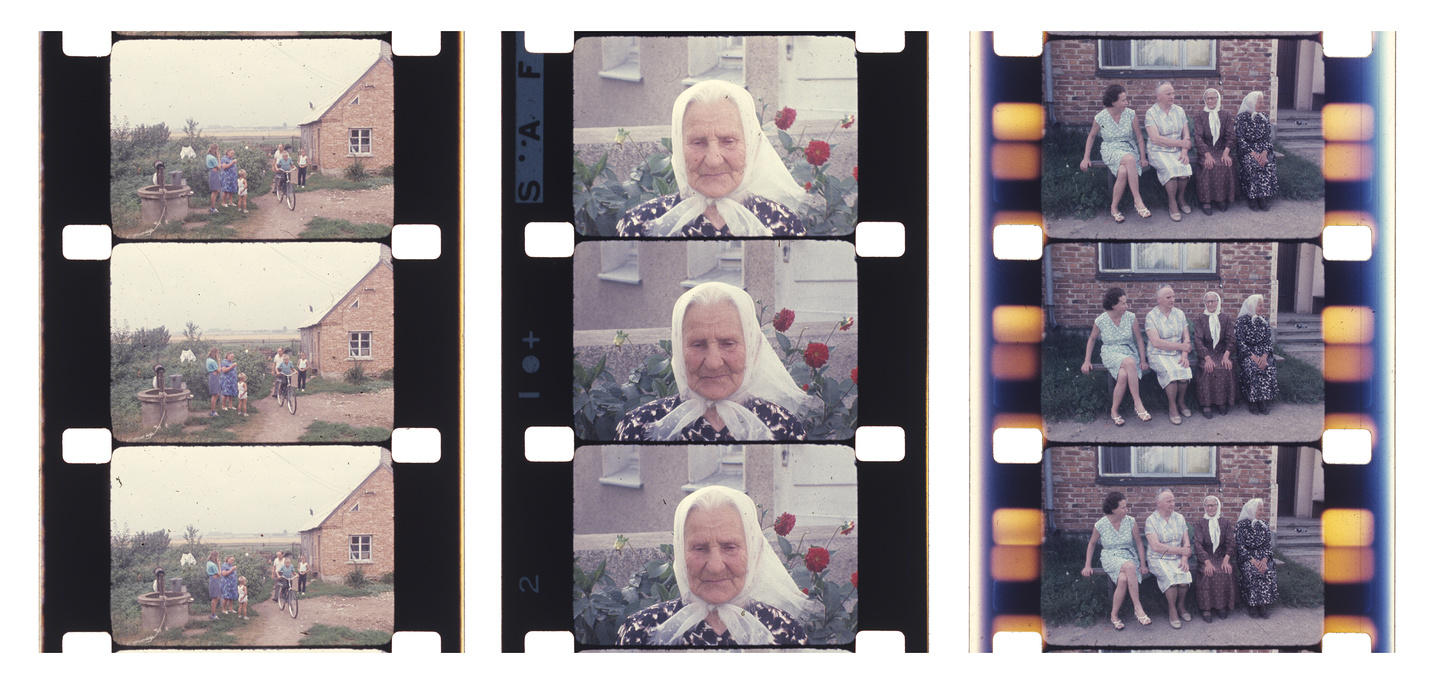
Jonas Mekas, frame sequence from Reminiscences of a Journey to Lithuania (1972), 16 mm film, color and black-and-white, sound, 82 min.
http://www.documenta14.de/en/artists/5572/jonas-mekas

«In the fifty-five years that I’ve known Jonas Mekas, I have never seen him without a camera, ready to use. First it was a 16 mm Bolex, then a series of video and digital recording devices. Today, most often, it’s a mobile phone. Mekas refers to himself simply as a “filmer” these days, rather than as a filmmaker. He never conceived of himself as a “film director.” Looking back at his enormous body of work in literature—poetry, essays, journals—and in film and photography, Mekas concludes that the form binding all of it together is the diary.

He does not use words casually. As a teenager (born in 1922), Mekas was a published poet in his native Lithuania even before he picked up his first camera to photograph the occupying German army on parade. An officer snatched the camera from his hand; Mekas was fortunate not to be snatched himself. But soon after, he and his younger brother Adolfas, realizing that they were wanted men, fled the country, bound for university in Vienna. They were quickly arrested and sent to a German forced labor camp. After the war, they lived for four years in displaced persons camps, one of them in Kassel. Jonas kept a diary during this period, later published as I Had Nowhere to Go (1991). He also acquired a still camera. The lens wasn’t very sharp, but Mekas’s eye was. His desire to bear witness—to record daily life, not only so that he would remember but so that history would take notice—began with photos of displaced people, waiting to return to their former lives or to begin life anew. Mekas could not go back to Lithuania, which, as he later wrote, had been “awarded to the Soviet Union.” The Soviets considered him as much a troublemaker as the Nazis had.

Instead, Mekas chose New York, and within months of arriving had scraped together enough money to buy his first Bolex camera. As he could barely afford rent and food, he conserved his precious film stock, shooting in extremely short bursts—just enough to capture the movement of time, to suggest how the present becomes memory. Or to put it another way, Mekas’s many diary films, including the most poignant among them, Reminiscences of a Journey to Lithuania (1972) are testaments to the struggle to live as a visionary in the present moment, knowing that the mind’s eye will always be suffused with the ghosts of the past.»

—Amy Taubin

Bas Smets, commissaire d’Agora 2017

Lu dans Le Monde Magazine, par Anne-Lise Carlo

«À la veille de la rentrée, Bas Smets joue les prolongations de son été américain.
C’est depuis le désert du Nevada que l’architecte belge spécialiste du paysage répond au téléphone, alors qu’il assiste au festival Burning Man, grand-messe artistique éphémère et déjantée. Sollicité pour réfléchir à une oeuvre de land-art (création extérieure en matériaux naturels) en 2018, Bas Smets observe la créativité des participants sur les terres ultra-arides d’un festival dopé à l’énergie solaire :  » Ici, c’est comme un paysage post-apocalyptique et encore une fois, l’on voit bien que c’est de la nécessité que naît l’inventivité des comportements humains « , ajoute-t-il.
C’est aussi ce qu’il veut démontrer à Agora, la biennale d’architecture, d’urbanisme et de design qui se tient du 14 au 24 septembre à Bordeaux. Lancée en 2004, Agora s’étale sur dix jours désormais – au lieu de sept il y a deux ans – et devrait dépasser le seuil des 55 000 visiteurs atteint en 2014 (deux fois plus qu’en 2012). La notoriété et l’énergie de Bas Smets, nouveau commissaire de cette biennale, permettront aux Bordelais d’écouter les architectes Christian de Portzamparc et Marc Barani, le designer Ora Ïto ou le directeur des Rencontres d’Arles Sam Stourdzé.
Mais Bas Smets veut surtout susciter la réflexion du grand public sur l’évolution constante de nos panoramas métropolitains.  » La population mondiale dépasse les 7,5 milliards et la moitié de ses habitants réside en milieu urbain. La perte de la nature est irréversible sans que l’on puisse estimer encore l’impact des changements climatiques. Il est donc temps de questionner nos ambitions en matière de paysages « , explique-t-il.
À l’occasion d’Agora, l’architecte s’est associé à des réalisateurs pour appuyer son idée. Leur but : raconter comment l' » homo urbanus  » s’adapte de manière singulière en fonction des latitudes. Ainsi, avec Bêka et Lemoine, réputés pour leurs films dépoussiérant l’architecture, il a observé à la loupe comment les excès climatiques et la géographie engendrent aussitôt des comportements-réponses des habitants, et par conséquent des économies informelles. Ainsi, ce SDF colombien qui, à la recherche d’un pourboire, aide les piétons à franchir les pluies torrentielles qui inondent Bogota en quelques minutes.  » Avec l’artiste-vidéaste Christian Barani, nous sommes allés voir comment répondre à la nécessité de contenir les montagnes friables de Hong-kong ou à l’ambition de transformer l’île de Singapour en jardin « , raconte Bas Smets.
Depuis son bureau de Bruxelles, le paysage urbain reste son quotidien. Sur sa carte de visite, il a apposé  » architecte du paysage  » et non paysagiste, qui est, selon lui, un abus de langage. Une nuance perçue d’emblée comme un acte de modernisation de cette science des espaces verts, toujours dans l’ombre de la grande architecture. En multipliant les collaborations avec des stars comme Frank Gehry ou la firme new-yorkaise REX Architecture, Bas Smets remet la matière verte sous le feu des projecteurs tout en cassant le moule. À 42 ans, il renvoie en effet sa profession à des années-lumière du jardinage en créant ses  » paysages augmentés « , intelligents et sophistiqués, destinés à rendre les mégalopoles plus vivables.
Pour les faire émerger, Bas Smets a ses secrets : il scrute les vues aériennes, redessine par-dessus la végétation, compare les cartes, saute en parachute… Ce rapport très physique au paysage, tel un sourcier, l’amène à saisir la logique d’un territoire et à trouver la meilleure voie possible cachée dans la réalité. à Arles, choisi par Maja Hoffmann, directrice de la Fondation Luma, il a fait éclore une  » boucle verte  » de 10 hectares dans le parc des Ateliers qui entourera bientôt la tour de Frank Gehry.  » Le projet accélère les processus naturels qui auraient eu lieu au fil du temps, en conquérant le site industriel abandonné « , explique Bas Smets. Plus récemment, son aménagement de 12 kilomètres d’une autoroute en Belgique a permis la plantation d’un rideau de 5 000 arbres volontairement indigènes. Bientôt, Bas Smets dessinera le futur d’un espace public autour du centre d’art Perelman, à New York, sur le site du World Trade Center. Seul frein à son savoir-faire, les images virtuelles dont l’architecture est si friande en amont d’un projet.  » Je n’aime pas ces projections car je ne peux pas garantir le résultat d’un paysage. La nature est cyclique, saisonnière et un nouveau paysage peut prendre du temps à se construire. En matière d’environnement, il ne faut pas oublier que l’on ne maîtrise pas tout « , lance-t-il. Soucieux, à l’inverse, du contrôle de sa propre image, il finit par s’inquiéter avant de raccrocher :  » Il vaut mieux ne pas dire que je suis à Burning Man sinon l’on va croire que je ne suis qu’un hippie illuminé! »
Anne-Lise Carlo