Takuma Nakahira

Vu au Bal, dans l’expo Provoke, les photos de Nakahira, « classique-moderne » :  « Le photographe, théoricien et critique Takuma Nakahira (1938-2015) est, avec Koji Taki (1928-2011), responsable de l’armature discursive de Provoke. Diplômé en Études espagnoles, grand connaisseur des mouvements d’indépendance latino-américains, Nakahira devient responsable éditorial de la revue culturelle de gauche Gendai no me (l’Oeil contemporain) entre 1964 et 1965. En 1968, il est un des quatre fondateurs de Provoke. Nakahira ne considère pas la photographie comme le moyen d’expression d’un artiste photographe, mais comme la simple capture mécanique d’une perception subjective. En 1970, il édite Kitarubeki kotoba no tame ni (Pour un langage à venir) son livre-manifeste,  suite d’images non-linéaire et sans hiérarchie, évoquant des scènes imaginaires et post-apocalyptiques. »

https://youtu.be/X_N75LZOxvU

img_0545

img_0549

Deux doubles pages de For a Language to Come, « described as « a masterpiece of reductionism. » Parr and Badger include it in the first volume of their photobook history. Up through its publication in 1970, Nakahira had been well versed in the style are, bure, boke (rough, blurred, and out of focus). In 1973, he published Why an Illustrated Botanical Dictionary (Naze, shokubutsu zukan ka), shifting away from the style of are, bure, boke (brut, flou et granuleux) and instead moving towards a type of catalog photography stripped of the sentimentality of handheld photography, a photography resembling the illustrations of reference books. »

For a Language to Come, exposé  au Bal, en mode dépliant faisant panoramique horizontalimg_4880 img_4881

Paysage médiatique selon Richard Serra. 1973


Televison Delivers People pris sur Youtube mais l’original est exposé sur Ubuweb http://www.ubu.com/film/serra_television.html. Sous-titrage sur Ubuweb : « Television Delivers People is a seminal work in the now well-established critique of popular media as an instrument of social control that asserts itself subtly on the populace through « entertainments, » for the benefit of those in power-the corporations that mantain and profit from the status quo. While canned Muzak plays, a scrolling text denounces the corporate masquerade of commercial television to reveal the structure of profit that greases the wheels of the media industry. Television emerges as little more than a insidious sponsor for the corporate engines of the world. By appropriating the medium he is criticizing-using television, in effect, against itself-Serra employs a characteristic strategy of early, counter-corporate video collectives-a strategy that remains integral to video artists committed to a critical dismantling of the media’s political and ideological stranglehold. » Traduction possible sur le site du crac Languedoc Roussillon. Deliver peut vouloir dire libérer, mais l’adjonction d’un complément d’attribution en donne le sens d’offrir à, comme dans le 3e statement : Televison delivers people to an advertiser > La télévision offre les gens à un annonceur. Circonstances de son exposition en 1973, décrites par William Kaisen : « Given Television Delivers People‘s strident criticism of the medium’s connection to commerce, it’s remarkable (and exceptional) that it was shown on a commercial channel. But despite its gloomy tone, when taken whole, it produced exactly the kind of oppositional voice that its content seemed to deem impossible. It rerouted the mass distribution that broadcasting affords by welling up from within commercial television in opposition to the usual network fare. The alienation effects it used —including the collision between the soundtrack and the image, and the focus on television as a space for reading as opposed to watching— turned the piece into something completely unlike the typical television program or advertisement of the day. By forgoing imagery, Serra et Schoolman transformed a primarily iconic medium into a symbolic one, converting distracted television watching into an act of textual contemplation. In so doing, they increased the audience’s understanding, by comparaison, of how television usually delivers people into the hands of an advertiser on an endless flow of hypnagogic pictures. By stopping the flow of images, they broke with television’s lulling effect, which the Musak’s ironic counterpoint only heightened. Airing their work as the station sign-off, Serra and Schoolman had the last word for the night. Instead of sending viewers to sleep with patriotic clichés, Television Delivers People offered a jolt of critical analysis before bed. It suggested to viewers that television might yet be capable of delivering the people somewhere beyond the constraints of the new media state. »

Bestioles et LOVE

img_4817
Cover de la tape de Diggi Dysberg telle qu’annoncée par lui sur Facebook: « Je suis présent sur la sorte de « Tape » #Bestioles avec mes vieux potos Ryu MC, Croco Mort & Davy!! Voilà des MC’s réunis sur une espèce de Mini compile qui va être assez #Zinzin… Y’a des fourbes comme ПИРАТ НИТРО dans l’affaire, les reuftons Félix Marcy & Arthur Tehar Marcy, Des beats de Mikhaël Opï Nine & de Trigga Trigga Man,Le #Goblin qu’on nomme Johnny Gonzo pour les visuels, Le MARVYLLAIN à la console, et moi même à la A&R!! ÇA VA ÊTRE STRRRRANGE 😀 déjà disponible ». Lettrines végétalisées attaquées de toutes parts, grouillantes et terriblement vivaces mais impeccablement lisibles.

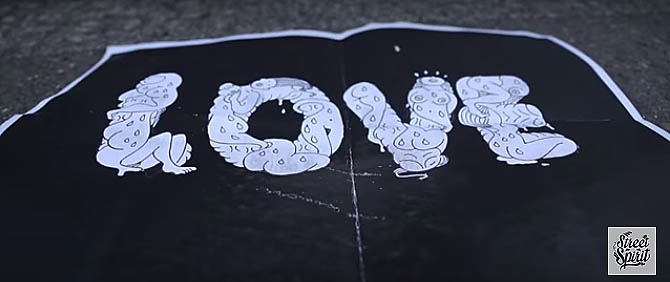
LOVE, du même artiste, mais en mode graffiti art de lettrines à taille humaine, si humaine, dont le contour comme la graisse subissent le même maelström interne sans affecter la lisibilité typographique voire en la décuplant.
love
…à 2mn 16 s. de la fin de la vidéo, on aperçoit, au sol, le modèle imprimé sur un feuillet A4.

Adorablement détestable#3

img_4948

img_0569

favela2-30favela1-30
Hall d’entrée de la Favela Chic : sur le mur à droite, 4 tirages sur papier A0 punaisés à même le mur, de dessins originaux A4 de J. Gonzo. Leur faisant face, 3 acryliques sur toile, décrites précédemment, se balançant quelque peu librement sur leur tige amarrée à une cimaise. Exposition Adorablement détestable#3, du 5 au 12 octobre 2016.

J.G. J’aurais pu

image
En cours… Un genre de Bruce Nauman dans son atelier: la peinture pense plus que la performance. Bruce Nauman « Wal’king in a Exaggerated Manner Around the Perimeter of a Square » 1/2 [1967-68]. Et la guerre ou la paix entre la page de texte et le portrait ecce homo. Quand le paysage est du texte et quel texte? En vente en ligne sur johnnygonzoartshop.tictail.com. En écho entre autres  à Raymond Pettibon, un artiste du texte & image, apprécié par J.G.